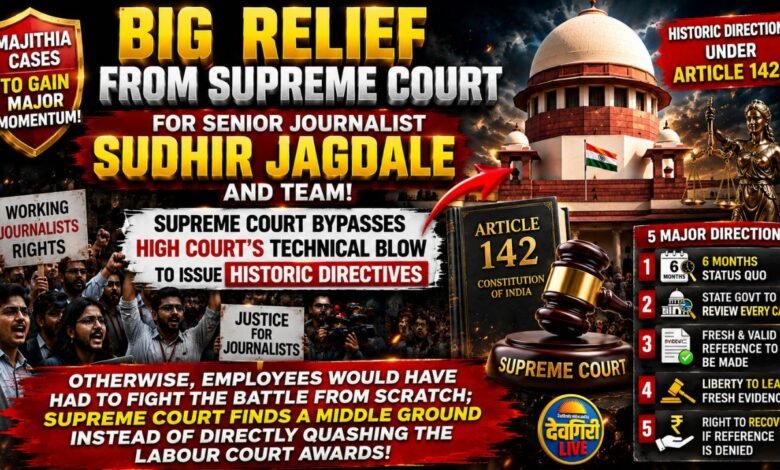
Big relief from the Supreme Court for senior journalist Sudhir Jagdale and team! Majithia cases to gain major momentum as Supreme Court bypasses High Court’s technical blow to issue historic directives under ‘Article 142’!!
...Otherwise, employees would have had to fight the battle from scratch; Supreme Court finds a middle ground instead of directly quashing the Labour Court awards!
NEW DELHI (Sudhir Bhaskar Jagdale):
In a major and deeply sensitive legal relief for working journalists fighting for their legitimate rights, the Supreme Court has issued a landmark order in the case of Sudhir Bhaskar Jagdale & Others v. Dainik Bhaskar. While partially accepting the High Court’s finding regarding a technical flaw in the Maharashtra Government’s 2014 notification—which had previously led to Labour Court awards being deemed unauthorized—the apex court invoked its extraordinary constitutional powers under Article 142 to prevent severe prejudice to the employees. Observing in open court that quashing the awards entirely based on a mere technicality would inflict grave injustice upon the workers, the Supreme Court directed the State Government to revisit all affected cases within the next six months and issue ‘valid references’.
Crucially, the Supreme Court pronounced this directive in open court today and opted not to sign the final order immediately, giving both parties an opportunity to review the directions and suggest any necessary additions or modifications.
What Transpired in the Open Court?
During the proceedings, the bench outlined two distinct parts of the judgment:

- The Jurisdictional Issue (Section 17(2)): The court agreed that Section 17(2) of the Working Journalists Act cannot be interpreted in a manner that allows the State Government to delegate its inherent power of satisfaction and reference to another authority (such as the Labour Commissioner). The High Court’s position on this technical aspect was legally upheld.
- The Transition to the New Labour Code: The court explicitly noted that the Working Journalists Act is no longer enforced, having been repealed with effect from 2025 by the implementation of the new Labour Codes. If the court were to simply declare the existing Labour Court awards invalid, the affected employees would be forced to re-initiate their entire legal struggle from scratch under the new code. To obviate this severe hardship, the bench exercised its plenary powers under Article 142 of the Constitution of India.
5 Major Directives Issued by the Supreme Court:
1. Six-Month Status Quo (Proceedings Kept Pending):
All proceedings currently before the Labour Courts or the High Court, at whatever stage they may be, shall remain pending as they are for a period of six months. No case will be dismissed on this technical jurisdictional ground during this time.
2. State Government to Revisit Every Case:
During this six-month window, the State Government must revisit every single case where a reference had previously been made. The State Government must independently reach a subjective satisfaction that an arbitrable dispute exists which warrants a reference.
3. Fresh and Valid Reference to be Made:
Once the State Government reaches this satisfaction, it will make a further, legally valid reference directly to the Labour Court or the High Court where the matter is pending. This effectively cures the procedural defect originally flagged by the High Court.
4. Liberty to Lead Fresh Evidence:
If a matter is actively pending before the Labour Court and either party wishes to adduce fresh evidence to substantiate their claims, the Supreme Court has explicitly permitted both the employees and the opponents to lead such evidence.
5. Right to Recovery if Reference is Denied:
In the event that the State Government decides a particular dispute is not referable, it is mandated to formally intimate the concerned employee. Upon receiving such an intimation, the employee will have the complete liberty of instituting recovery proceedings in accordance with law. Crucially, the period of limitation for such recovery will only begin from the exact date this official intimation is handed to them.
Why the Bench Did Not Sign the Order Immediately
While concluding the dictation, the Hon’ble Judges stated to the counsel of both sides, “We will not sign the order right now. Just let both parties look into the directions. If any addition is to be done or if you feel something has been missed out which would impede the progress of the proceedings, please let us know. We will incorporate it.” This proactive stance by the judiciary ensures that the operational mechanism of this relief remains foolproof for working journalists.